Pathology reports for cancer participants
Pathology investigations are the gold standard for diagnosing and characterising cancers. Pathology reports allow you to see the thinking and detailed findings of the imaging investigations (pathology slides) in the context of the patient timeline.
We previously released pathology reports using an older anonymisation pipeline. We have new data received in late 2024 which includes more reports covering thousands more participants and a newer pipeline which significantly reduces over-redaction of clinically useful information, which means there is more data of better quality.
Data overview
There are details of 75066 reports, from 21853 participants. The following table lists the breakdown per programme:
| reports | participants with reports | |
|---|---|---|
| Cancer | 59,234 | 16,259 |
| Rare Diseases | 15,832 | 5,594 |
Many participants present more than one report. Below is the distribution of number of reports per programme:
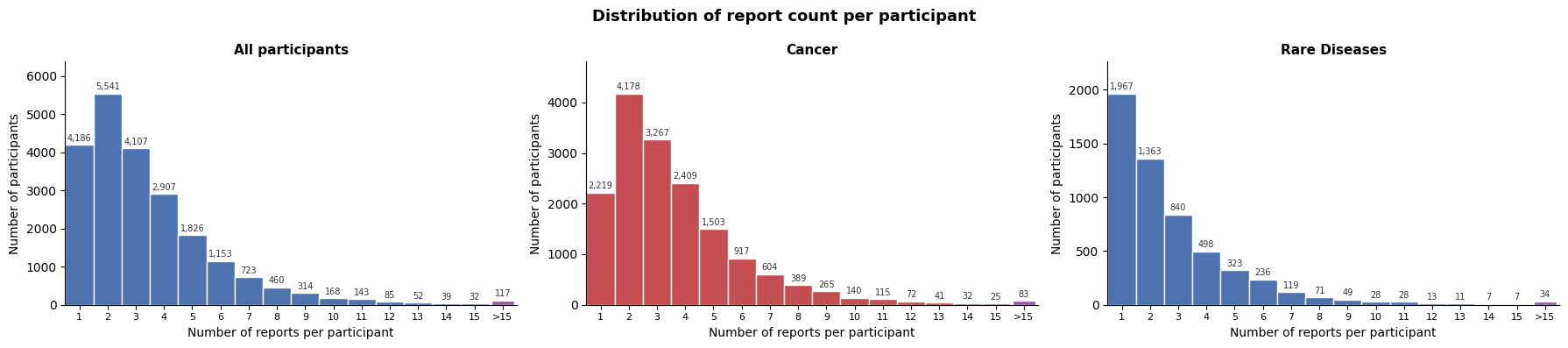
Many participants present more than one report. Below is the distribution of number of reports per programme:
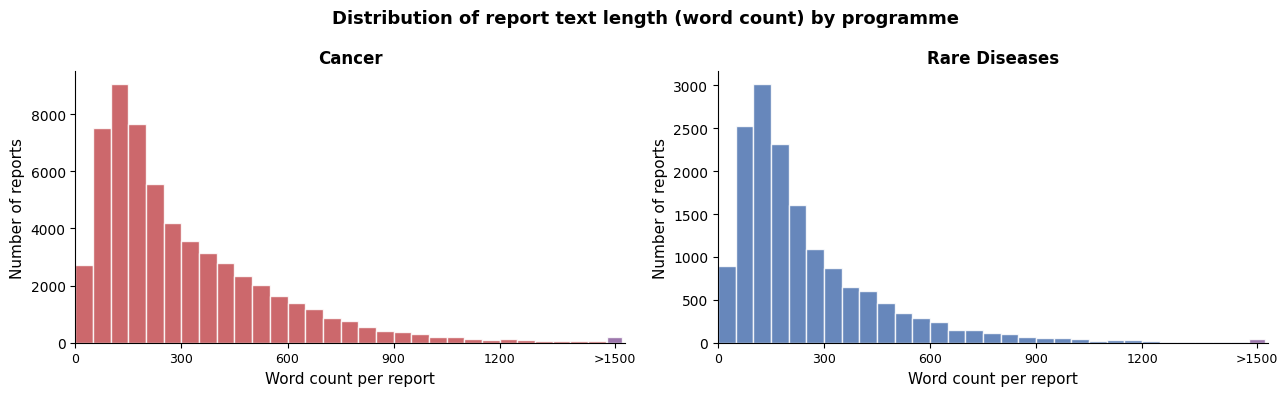
The following table lists the breakdown by cancer type:
| disease type | image count | participant count |
|---|---|---|
| BREAST | 11381 | 2884 |
| COLORECTAL | 10371 | 2764 |
| SARCOMA | 6397 | 1724 |
| LUNG | 6094 | 1538 |
| RENAL | 3834 | 1441 |
| ENDOMETRIAL_CARCINOMA | 2899 | 838 |
| OVARIAN | 1892 | 608 |
| ADULT_GLIOMA | 1529 | 588 |
| PROSTATE | 1679 | 560 |
| HAEMONC | 2186 | 534 |
| BLADDER | 1456 | 403 |
| MALIGNANT_MELANOMA | 2305 | 342 |
| HEPATOPANCREATOBILIARY | 1075 | 335 |
| UPPER_GASTROINTESTINAL | 1060 | 267 |
| ORAL_OROPHARYNGEAL | 1111 | 254 |
| CHILDHOOD | 695 | 195 |
| CARCINOMA_OF_UNKNOWN_PRIMARY | 708 | 97 |
| TESTICULAR_GERM_CELL_TUMOURS | 124 | 58 |
| ENDOCRINE | 70 | 23 |
| SINONASAL | 63 | 19 |
| NASOPHARYNGEAL | 50 | 8 |
| OTHER | 23 | <5 |
Data context and applications
We have seen researchers reading these reports and creating their own labels or patient timelines for their analyses, or using them to check that their classification from other clinical data sources. If you need to create labels across a large participant cohort, consider raising a Service Desk ticket as there is labelling expertise in-house that can automate the process while allowing you to check any results for yourself.
If you are using the pathology imaging dataset, you should identify the corresponding report for the pathology case. The set of pathology images for a participant usually corresponds to one report but may correspond to multiple. The report will give valuable context, such as the date, cause and findings of the investigation, as well as block keys that allow the researcher to identify which slides contain tumour, lymph nodes or other tissue, as well as the presence of stains.
If you are using the older dataset and wish to use or compare the newer data, please use the gel_report_id field, which if it matches a record in the older dataset should refer to the same report.
This data can be found at s3://907999473992-pathimages-consent/20260601_pathology_reports.tsv.
You can access the data from the RE at /mnt/pathology-images/20260601_pathology_reports.tsv
In CloudOS you will need to mount s3://907999473992-pathimages-consent/
Pathology Reports and associated slides
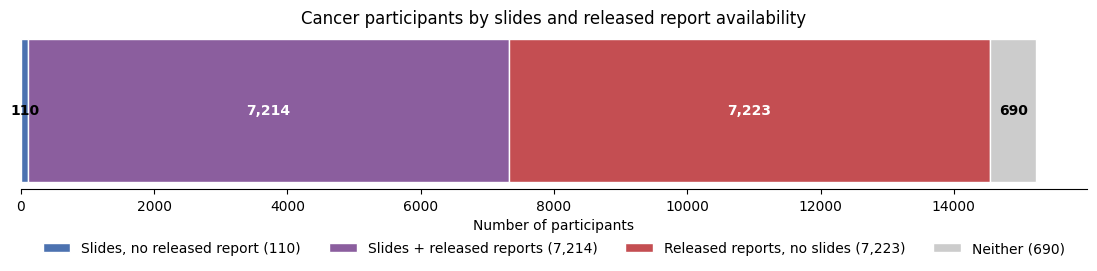
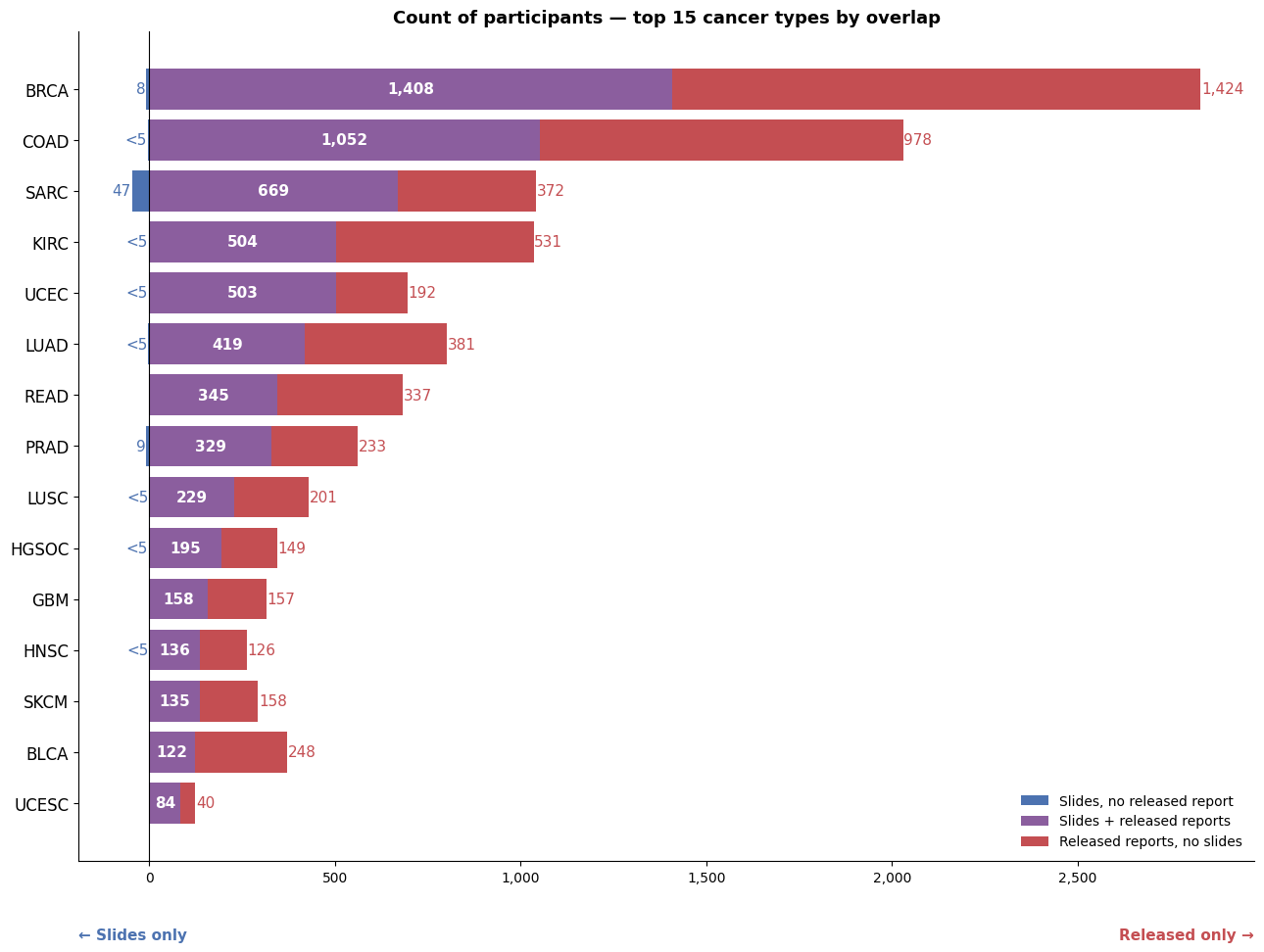
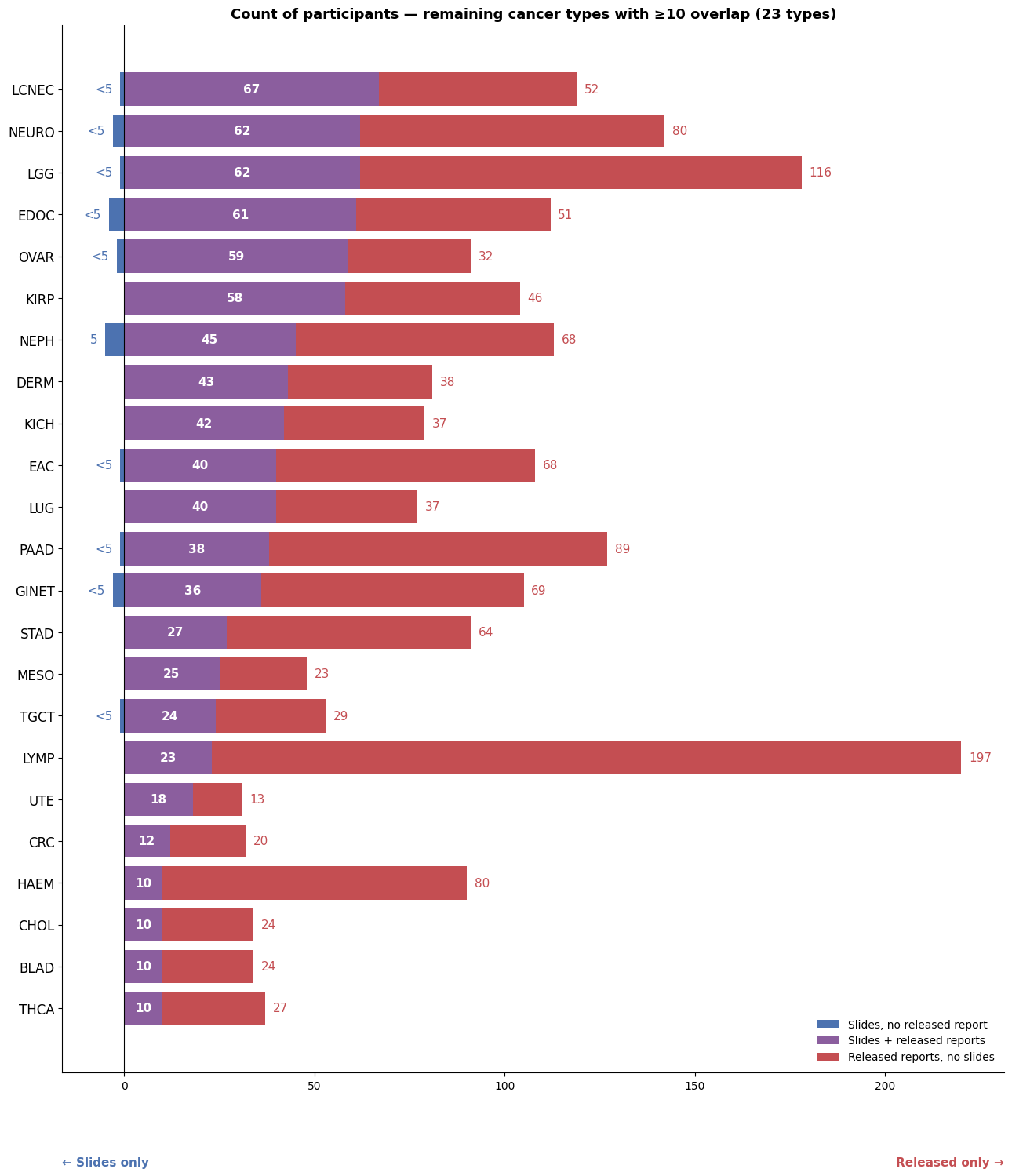
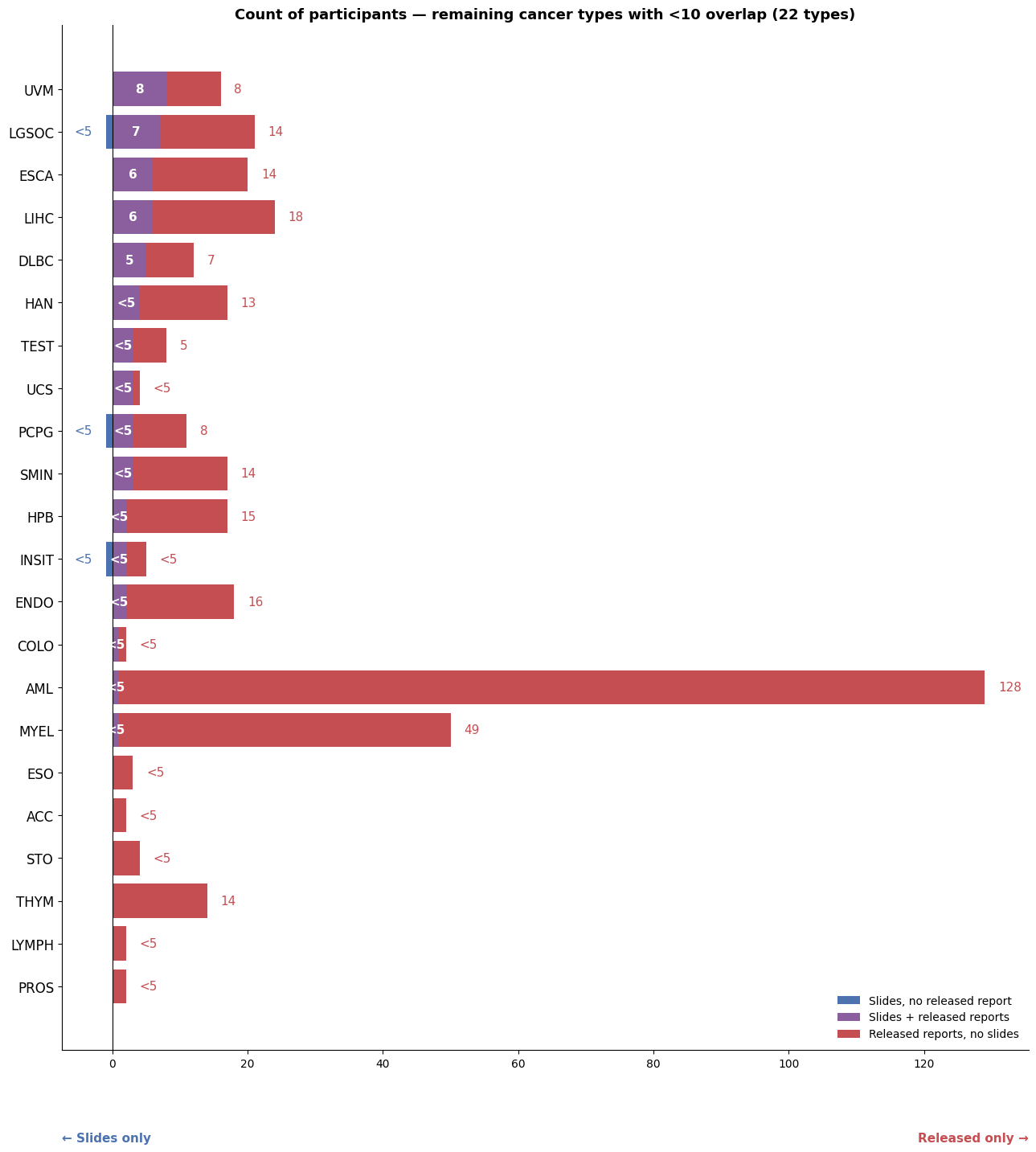
The pathology reports are often used in combination with the pathology slides. Below you can observe how the overall overlap and the overlap per cancer type:
The distribution by study abbreviation can be found in three separate plots. The first one contains the top 15 cancer types (by number of participants that have both slides and reports - purple bar). The second contains the remaining cancer types with more than 10 participants with both slides and reports. The final plot contains contains all other cancer types.
Data dictionary
| column | data type | example | notes |
|---|---|---|---|
gel_report_id |
string | report_0006_000056 |
Unique identifier of each row/report. |
participant_id |
string | 111000055 |
Use this field to link to other tables across the Research Environment |
received_date |
datetime64[ns] | 2021-03-24 |
This date is a combination of "collected date" when available, followed by "received date" and finally "authorised date". |
redacted_text |
string | CLINICAL DETAILS:\nRight central excision of n... |
The redacted (anonymised) report. |